
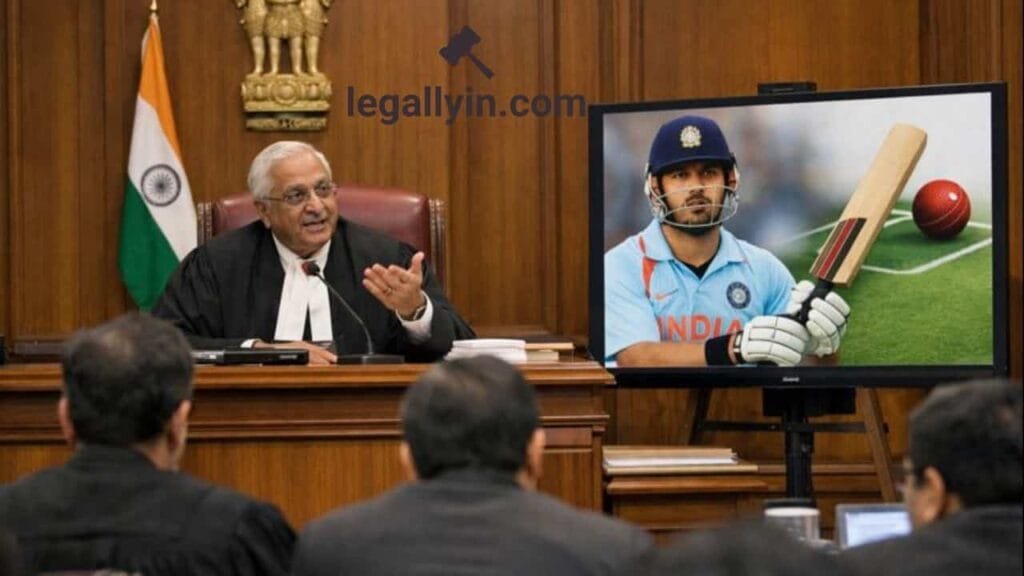
New Delhi: A recent courtroom observation by a Supreme Court Judge’s Cricket Analogy and referencing former Indian cricketer Gautam Gambhir, has gone viral on social media, sparking widespread public discussion and media attention.
The remark was made during a live court session and quickly gained traction online for its cultural relevance and relatable tone. Videos and excerpts from the hearing were widely shared, turning a routine judicial proceeding into a trending topic across digital platforms.
What Did the Supreme Court Judge Say?
During the hearing, the judge used a cricket-related analogy involving Gautam Gambhir to illustrate a broader point linked to responsibility, performance, or decision-making. While the observation was not part of the final judgment, it served as an explanatory remark to clarify the court’s reasoning.
The reference stood out for blending legal reasoning with a familiar sporting context, making the courtroom exchange instantly relatable to the public.
Why the Remark Attracted Attention
The analogy resonated strongly for several reasons:
- Cricket’s cultural importance in India
- Gautam Gambhir’s public recognition, both as a former international cricketer and a political figure
- The rare intersection of law and popular culture in Supreme Court proceedings
As a result, the judge’s statement quickly became a viral clip, discussed widely beyond legal circles.
Gautam Gambhir Reference and Its Broader Meaning
Gautam Gambhir is widely known for his performances in high-pressure cricket matches and his outspoken public image. By referencing him, the judge highlighted qualities often discussed in legal contexts, such as:
- Accountability
- Responsibility under pressure
- Impact of individual decisions
- Public expectations from leadership roles
Legal experts noted that such analogies help simplify complex arguments without compromising judicial seriousness.
Are Such Analogies Common in the Supreme Court?
While not routine, Indian courts — including the Supreme Court — have previously used metaphors and examples from everyday life, sports, literature, and history to make legal reasoning more accessible.
These oral remarks are illustrative in nature and do not constitute binding legal precedent. However, they often attract public attention, especially in the age of instant digital sharing.
Legal Status of Viral Courtroom Remarks
It is important to note that:
- Oral observations during hearings do not carry legal force
- Only written judgments and orders are binding
- Such remarks are intended to aid understanding, not establish law
Despite this, they play a significant role in shaping public perception of the judiciary.
Read More: Supreme Court Flags Serious Banking Lapses in Cyber Fraud Cases: Need for Strong Alert & Early Warning Systems
Presumption in Section 138 Cases: Presumption in Cheque Bounce Cases Explained
Public and Social Media Reaction
The viral clip received largely positive reactions online. Many users appreciated the judge’s relatable explanation, while legal commentators highlighted the effectiveness of using real-world examples to convey judicial reasoning.
The moment also triggered broader conversations about transparency, accessibility of legal proceedings, and the increasing public visibility of courtrooms through digital media.
Judiciary and Popular Culture in the Digital Era
With court proceedings now frequently reported in real time, even brief courtroom remarks can gain widespread attention. Experts believe such moments reflect a judiciary that is conscious of public communication while maintaining institutional dignity.
The incident underscores how legal discourse, when expressed in familiar language, can bridge the gap between courts and citizens.
The Supreme Court judge’s cricket analogy involving Gautam Gambhir is a reminder that law and society are closely connected. While firmly grounded in legal reasoning, the judiciary’s ability to communicate through relatable examples helps make justice more understandable to the public.
As this moment shows, even within the formal setting of the Supreme Court, words can travel far beyond the courtroom — shaping conversation, perception, and public engagement with the justice system.