
What is Sessions Trial?
Sessions Trial refers to the trial of serious criminal offences conducted before a Court of Session, which is presided over by a Sessions Judge or an Additional Sessions Judge. understanding the What is Sessions Trial? under Sections 248 to 262 BNSS is essential , as it forms the backbone of criminal justice in serious offences.
🔹 Meaning of Sessions Trial
A Sessions Trial refers to the trial of serious criminal offences conducted before a Court of Session, which is presided over by a Sessions Judge or an Additional Sessions Judge.
These trials are generally conducted in cases where:
- The offence is grave in nature
- The punishment may extend to life imprisonment or death penalty
🔹 Legal Provisions Governing Sessions Trial
👉 Under the Code of Criminal Procedure (CrPC)
- Sections 225 to 237 CrPC
👉 Under Bharatiya Nagarik Suraksha Sanhita (BNSS), 2023
- Corresponding provisions broadly fall under Sections 248 to 262 BNSS (section numbers may vary slightly based on final enactment versions—always cross-check bare act while drafting)
🔹 Comparison Table (CrPC vs BNSS)
| Stage | CrPC Section | BNSS Section |
| Prosecution by PP | 225 | 248 |
| Opening case | 226 | 249 |
| Discharge | 227 | 250 |
| Charge | 228 | 251 |
| Plea of guilty | 229 | 252 |
| Evidence | 230–231 | 253–254 |
| Statement of accused | 313 | 351 |
| Defence evidence | 233 | 256 |
| Judgment | 235 | 258 |
| Previous conviction | 236–237 | 259–260 |
🔹 Court of Session – Jurisdiction and Powers
The Court of Session is established under criminal law to try serious offences.
Key powers:
- Can award any sentence including death penalty
- However, death sentence requires confirmation by High Court
- Exercises original jurisdiction in serious criminal matters
🔹 Committal of Case to Court of Session
👉 Section 209 CrPC | Corresponding BNSS Provision
A Sessions Trial begins only after the case is committed by a Magistrate.
Role of Magistrate:
- Takes cognizance
- Supplies documents to accused
- Commits case to Sessions Court
Practical Insight:
Defects in committal (like incomplete documents) can delay trial and become a defence strategy.
🔹 Role of Public Prosecutor
👉 Section 225 CrPC | Section 248 BNSS
- Every Sessions Trial must be conducted by a Public Prosecutor
- Ensures fair prosecution, not conviction at any cost
🔹 Opening of Case
👉 Section 226 CrPC | Section 249 BNSS
- Prosecution outlines:
- Charges
- Evidence
- Theory of case
👉 This stage sets the tone of the entire trial.
🔹 Discharge of Accused
👉 Section 227 CrPC | Section 250 BNSS
The judge may discharge the accused if:
- There is no sufficient ground to proceed
Legal Standard:
- Court checks for prima facie case
- No detailed appreciation of evidence
🔹 Framing of Charge
👉 Section 228 CrPC | Section 251 BNSS
If sufficient grounds exist:
- Court frames charges
- Accused is formally informed
Key Insight:
- Strong suspicion is sufficient
- Not proof beyond reasonable doubt
🔹 Plea of Guilty
👉 Section 229 CrPC | Section 252 BNSS
- If accused pleads guilty:
- Court may convict
- But must ensure plea is voluntary
🔹 Prosecution Evidence
👉 Sections 230–231 CrPC | Sections 253–254 BNSS
Includes:
- Examination-in-chief
- Cross-examination
- Re-examination
Practical Insight:
Cross-examination is the most powerful tool in trial advocacy.
🔹 Statement of Accused
👉 Section 313 CrPC | Section 351 BNSS
- Accused is given opportunity to explain evidence
- No oath is administered
👉 This is a crucial safeguard of natural justice
🔹 Defence Evidence
👉 Section 233 CrPC | Section 256 BNSS
- Accused may:
- Produce witnesses
- Submit evidence
👉 Often underutilized but strategically important
🔹 Final Arguments
👉 Section 234 CrPC | Corresponding BNSS Provision
- Both sides present final submissions
- Case is analyzed legally and factually
🔹 Judgment
👉 Section 235 CrPC | Section 258 BNSS
- Court delivers:
- Acquittal OR
- Conviction
👉 Must be a reasoned judgment
🔹 Hearing on Sentence
👉 Section 235(2) CrPC | BNSS Equivalent
- Separate hearing after conviction
- Accused gets chance to present mitigating factors
👉 Based on principles of natural justice
🔹 Previous Conviction
👉 Sections 236–237 CrPC | Sections 259–260 BNSS
- Court considers past convictions for sentencing
🔹 Flow of Sessions Trial
- FIR
- Investigation
- Charge Sheet
- Committal to Sessions Court
- Opening of case
- Discharge / Framing of charge
- Prosecution evidence
- Statement of accused
- Defence evidence
- Arguments
- Judgment
- Sentencing
Read More: Doctrine of Res Gestae: Complete Guide with Case Laws
🔹 Important Case Laws
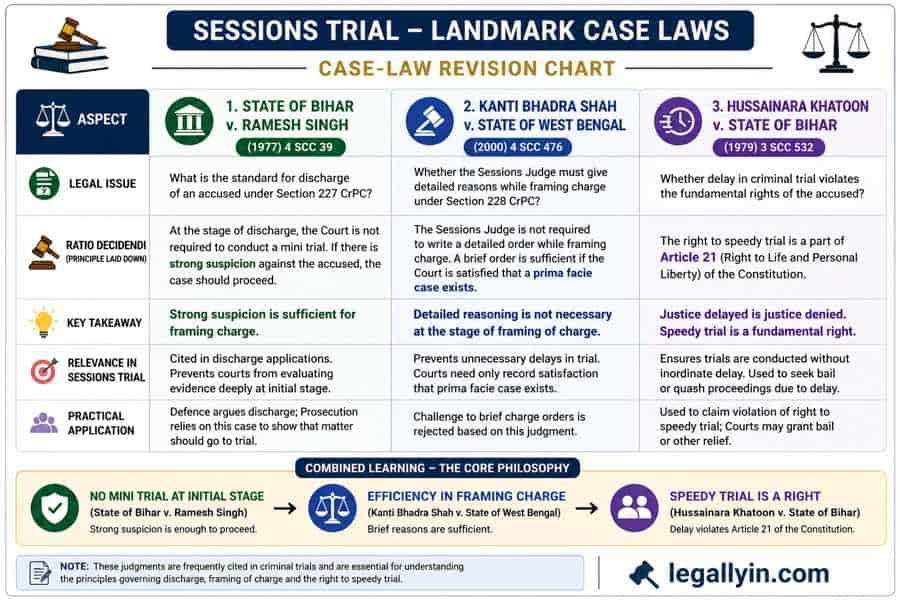
🔥 1. State of Bihar v. Ramesh Singh
🔹 Background
The accused was facing criminal charges, and the issue before the Court was:
👉 When can an accused be discharged under Section 227 CrPC?
🔹 Legal Issue
- What is the standard for discharge?
- Should the court conduct a detailed evaluation of evidence?
🔹 Supreme Court Held
The Court laid down a very important principle:
👉 At the stage of discharge, the court is not required to conduct a mini trial
👉 If there is strong suspicion against the accused, the case should proceed
🔹 Practical Court Insight
- Defence lawyers often try to argue facts deeply at discharge stage ❌
- But courts usually reject it because:
- Evidence is not to be fully tested at this stage
👉 This case is frequently cited in discharge applications
🔥 2. Kanti Bhadra Shah v. State of West Bengal
🔹 Background
The issue was regarding framing of charge under Section 228 CrPC.
🔹 Legal Issue
- Whether the judge must give detailed reasons while framing charges?
🔹 Supreme Court Held
👉 The Sessions Judge is not required to write a detailed order
👉 A brief order is sufficient if:
- Court is satisfied that a prima facie case exists
🔹 Practical Insight
- Many lawyers argue:
“Order is invalid because reasons are not detailed”
👉 This case clearly rejects that argument
🔹 Importance
- Speeds up trial process
- Prevents unnecessary delay
🔥 3. Hussainara Khatoon v. State of Bihar
🔹 Background
This case exposed a shocking reality:
👉 Thousands of undertrial prisoners were in jail for years without trial
🔹 Legal Issue
- Whether delay in trial violates Fundamental Rights
🔹 Supreme Court Held
👉 Right to speedy trial is part of:
Article 21 – Right to Life and Personal Liberty
🔹 Impact on Sessions Trial
- Courts must ensure:
- Trial is conducted without unnecessary delay
- Accused is not kept in custody indefinitely
🔹 Practical Court Insight
- Defence lawyers use this case to:
- Seek bail
- Argue for quashing due to delay
🔹 Importance
This case completely changed Indian criminal law by making speedy trial a constitutional right.
🔹 Difference Between Sessions Trial and Warrant Trial
| Point | Sessions Trial | Warrant Trial |
| Court | Sessions Court | Magistrate |
| Offences | Serious | Less serious |
| Prosecutor | Mandatory | Not mandatory |
| Punishment | Severe | Comparatively less |
🔹 Practical Courtroom Insights
- Delays often occur due to adjournments and witness absence
- Cross-examination can make or break the case
- Judges play an active role in controlling proceedings
- Defence lawyers often use technical defects strategically
🔹 FAQs
Q1. What is a Sessions Trial?
Trial of serious offences before Court of Session.
Q2. Can Sessions Court award death penalty?
Yes, but subject to High Court confirmation.
Q3. What is discharge under Section 227 CrPC?
Release of accused when no sufficient ground exists.
Q4. What is difference between discharge and charge?
Discharge ends proceedings; charge begins trial.
🔹 Conclusion
Sessions Trial is the foundation of criminal adjudication in serious offences. It ensures that cases involving grave crimes are tried with procedural fairness, judicial scrutiny, and adherence to principles of natural justice.
For every law student and practitioner, mastering this procedure is not optional—it is essential.