
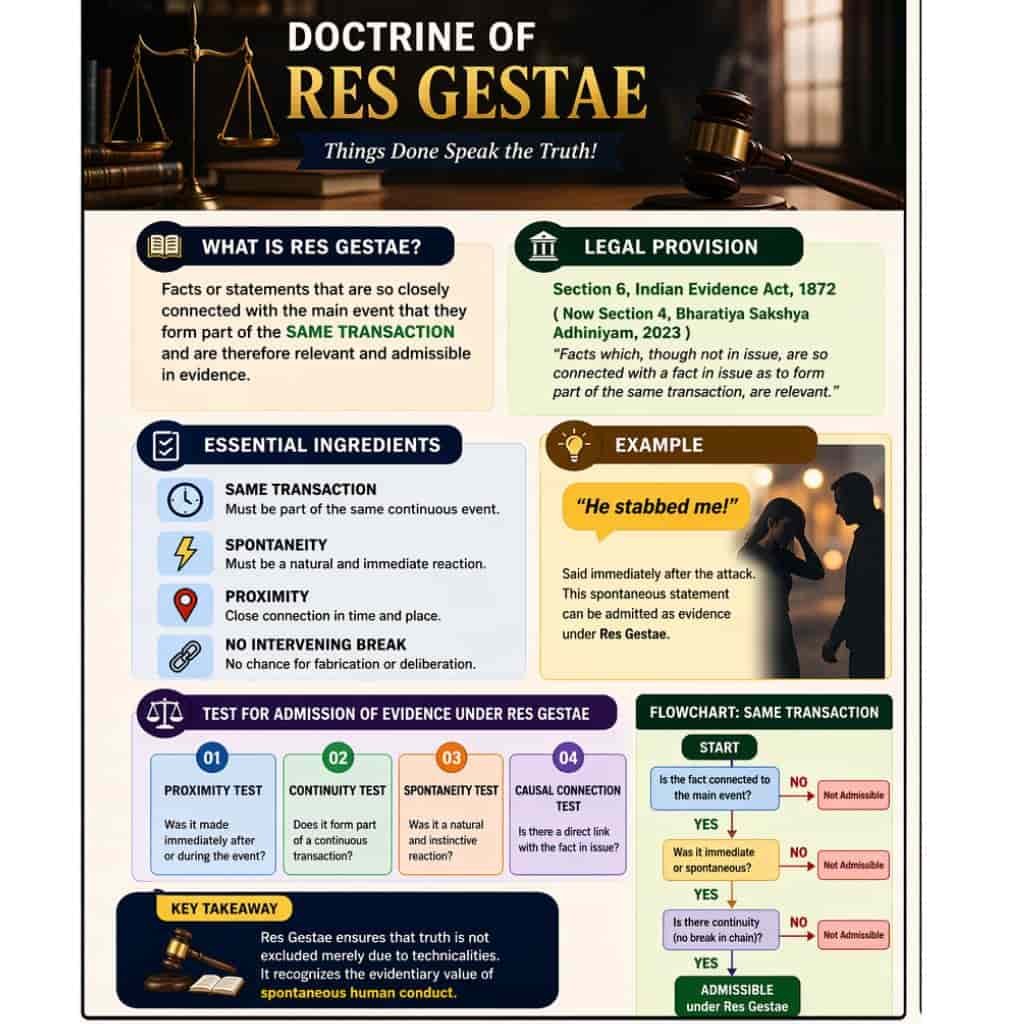
Consider a situation where a victim, immediately after being attacked, runs out crying, “He stabbed me!”—should this spontaneous statement be ignored merely because it was not made under oath? the law recognizes an important exception to this known as the Doctrine of Res Gestae codified under Section 6 of the Indian Evidence Act, 1872. And in Section 4 of the Bharatiya Sakshya Adhiniyam, 2023 This doctrine allows certain statements and acts, closely connected with the main event, to be admissible as evidence.
Res Gestae Meaning
The term Res Gestae is derived from Latin, meaning “things done”. It refers to those facts which are so intimately connected with a fact in issue that they form part of the same transaction.
This doctrine originated in English common law and was later incorporated into Indian evidence law to ensure that truth is not excluded merely due to technical rules.
Section 6 Evidence Act Explained
Statutory Provision
Section 6 provides that:
“Facts which, though not in issue, are so connected with a fact in issue as to form part of the same transaction, are relevant…”
| Definition : Section 4 of the Bharatiya Sakshya Adhiniyam, 2023 |
|---|
| Section 4 Relevancy of facts forming part of same transaction. Facts which, though not in issue, are so connected with a fact in issue or a relevant fact as to form part of the same transaction, are relevant, whether they occurred at the same time and place or at different times and places. Illustrations. (a) A is accused of the murder of B by beating him. Whatever was said or done by A or B or the bystanders at the beating, or so shortly before or after it as to form part of the transaction, is a relevant fact. (b) A is accused of waging war against the Government of India by taking part in an armed insurrection in which property is destroyed, troops are attacked and jails are broken open. The occurrence of these facts is relevant, as forming part of the general transaction, though A may not have been present at all of them. (c) A sues B for a libel contained in a letter forming part of a correspondence. Letters between the parties relating to the subject out of which the libel arose, and forming part of the correspondence in which it is contained, are relevant facts, though they do not contain the libel itself. (d) The question is, whether certain goods ordered from B were delivered to A. The goods were delivered to several intermediate persons successively. Each delivery is a relevant fact. |
Simple Explanation
In simple terms, any fact, statement, or act which is part of the same continuous transaction as the main incident becomes relevant, even if it would otherwise be considered hearsay.
For example:
- A person hears a gunshot and immediately sees someone running away shouting “I killed him”—this statement may be admissible under Res Gestae.
Essential Ingredients of Res Gestae
1. Same Transaction
There must be a clear connection between the fact in issue and the statement or act. It should form part of one continuous narrative.
2. Spontaneity
The statement must be made instantly or immediately, leaving no scope for fabrication.
3. Proximity of Time and Place
There should be closeness in time and location between the event and the statement.
4. No Intervening Circumstances
Any break in the chain may destroy the applicability of the doctrine.
Test for Admission of Evidence under Res Gestae
Courts have evolved specific tests to determine admissibility:
1. Proximity Test
- Was the statement made immediately after or during the event?
2. Continuity Test
- Does it form part of a continuous transaction?
3. Spontaneity Test
- Was it a natural reaction without premeditation?
4. Causal Connection Test
- Is there a direct link between the fact in issue and the statement?
👉 If these tests are satisfied, the evidence is admissible under Res Gestae.
Types of Facts Admissible under Res Gestae
- Statements (oral or verbal reactions)
- Acts (conduct during the occurrence)
- Exclamations (sudden emotional utterances)
- Circumstances (environmental facts connected to the event)
Illustrations for Better Understanding
Simple Illustration
A woman screams “Help! He is attacking me!” during an assault—this is admissible.
Legal Illustration
A witness hears a gunshot and immediately hears someone confess—admissible under Res Gestae.
Real-Life Scenario
After a road accident, the victim says, “The truck driver was drunk”—if said immediately, it may be relevant.
Landmark Case Laws
R v. Bedingfield
- Statement made after reaching a safe place was rejected
- Principle: Must be part of the transaction, not after it
Teper v. R
- Courts warned against misuse of Res Gestae
- Statements must be strictly scrutinized
Rattan Singh v. State of Himachal Pradesh
- Statement made immediately after incident was admitted
Sukhar v. State of Uttar Pradesh
- FIR-related spontaneous statements can fall under Res Gestae
Gentela Vijayavardhan Rao v. State of Andhra Pradesh
- Explained “same transaction” in detail
Significant points to consider as per courts interpretation
- “Same transaction” is not defined but interpreted broadly
- Time gap is not decisive; continuity is key
- Spontaneity is the most crucial factor
Read More: What is Trial in Absentia under Bharatiya Nagarik Suraksha Sanhita, 2023
Difference Between Res Gestae and Hearsay Evidence
| Basis | Hearsay | Res Gestae |
| Nature | Generally inadmissible | Exception to hearsay |
| Timing | May be delayed | Must be immediate |
| Reliability | Doubtful | Considered reliable due to spontaneity |
Distinction from Other Concepts
- Admission: Voluntary acknowledgment, not necessarily spontaneous
- Confession: Specific to criminal liability
- Dying Declaration: Made in contemplation of death
👉 Res Gestae differs as it is based on spontaneous connection with the event
Scope and Limitations
Scope
- Wide judicial interpretation
- Includes acts, statements, and circumstances
Limitations
- Risk of misuse
- Requires strict judicial scrutiny
- Must not be used to bypass hearsay rule casually
Critical Analysis
The doctrine plays a crucial role in ensuring justice by admitting natural human reactions. However, its subjective interpretation may lead to inconsistent application. Courts must strike a balance between relevance and reliability.
Modern Relevance in Digital Era
In this present period, Res Gestae has gained new dimensions:
- WhatsApp messages sent immediately after an incident
- Live social media recordings
- CCTV footage capturing real-time reactions
The doctrine continues under the new framework of Bharatiya Sakshya Adhiniyam, 2023, ensuring its relevance in modern evidence law.
Practical Application for Lawyers
- Establish continuity of transaction
- Prove absence of time for fabrication
- Use corroborative evidence (CCTV, witnesses)
- Avoid relying on delayed statements
Judicial Trends in India
Indian courts have adopted a balanced approach:
- Liberal in genuine cases
- Strict where chances of fabrication exist
FAQs
Q1. What is Res Gestae in simple words?
It means facts or statements forming part of the same transaction are admissible as evidence.
Q2. Is FIR part of Res Gestae?
It may be, if filed immediately and contains spontaneous statements.
Q3. Can delay destroy Res Gestae?
Yes, delay may break the chain of continuity.
Q4. Is it applicable in civil cases?
Yes, it applies to both civil and criminal cases.