
The law relating to FIR registration has undergone an important change after the enforcement of the Bharatiya Nagarik Suraksha Sanhita, 2023 (BNSS). Section 173 FIR BNSS is now the central provision governing registration of FIRs in India and has replaced old Section 154 CrPC. The provision not only retains the mandatory duty of police to register FIRs in cognizable offences, but it also introduces a new concept of preliminary inquiry in certain categories of offences. Because of this change, Section 173 BNSS has become one of the most discussed procedural provisions among lawyers, judges, police officers, judiciary aspirants, and law students.
Recent Supreme Court and High Court decisions have clarified that Section 173 FIR BNSS cannot be used as a tool to delay justice, but at the same time it acts as a safeguard against mechanical and false FIR registrations in doubtful cases. (24 Law)
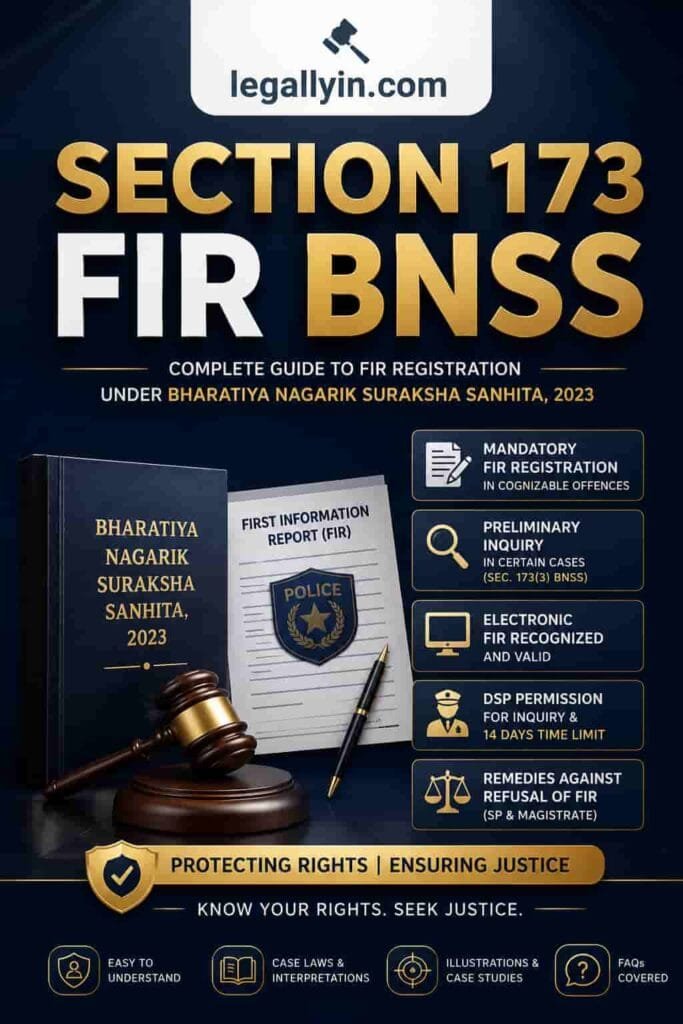
What is Section 173 FIR BNSS?
\text{Section 173 BNSS} \Rightarrow \text{Procedure for Information in Cognizable Cases (FIR)}
Section 173 of the Bharatiya Nagarik Suraksha Sanhita, 2023 deals with:
- Registration of FIR in cognizable offences
- Electronic FIR or information through electronic communication
- Preliminary inquiry in certain offences
- Remedy when police refuse to register FIR
- Duty of Superintendent of Police
- Rights of complainant
It corresponds to old Section 154 CrPC, but with important procedural additions.
Bare Essence of Section 173 FIR BNSS
Under Section 173 BNSS:
- Every information relating to commission of a cognizable offence must be reduced into writing.
- Information can also be given electronically.
- Such electronic information must be signed within 3 days.
- Police officer must provide a free copy of FIR to informant.
- In offences punishable between 3 to 7 years, police may conduct preliminary inquiry before FIR registration with prior permission of DSP.
- Preliminary inquiry must ordinarily be completed within 14 days.
- If SHO refuses to register FIR, complainant may approach Superintendent of Police.
Section 173 FIR BNSS vs Section 154 CrPC
| Point | Section 154 CrPC | Section 173 FIR BNSS |
| FIR Registration | Mandatory | Mandatory |
| Electronic FIR | Limited recognition | Specifically recognized |
| Preliminary Inquiry | Based mainly on judicial precedents | Statutorily incorporated |
| Time limit for inquiry | No statutory limit | 14 days |
| DSP Permission | Not required | Required in certain cases |
| Digital procedure | Minimal | Expanded |
The Supreme Court has observed that Section 173(3) BNSS introduces a “significant departure” from old CrPC procedure because now preliminary inquiry has statutory recognition. (LawTech)
Section 173(1) BNSS – Mandatory FIR Registration
Section 173(1) BNSS preserves the basic principle laid down in:
Lalita Kumari v. Government of Uttar Pradesh
The Constitution Bench of the Supreme Court held that:
- FIR registration is mandatory where information discloses commission of cognizable offence.
- Police cannot conduct roving inquiry before FIR in ordinary situations.
- Delay in FIR can destroy evidence and weaken investigation.
This principle still applies under BNSS. (Live Law)
Section 173(3) BNSS – Preliminary Inquiry Before FIR
This is the most important and controversial addition under BNSS.
When Preliminary Inquiry Can Be Conducted
Preliminary inquiry may be conducted where:
- Offence is punishable with imprisonment between 3 years to 7 years
- Police officer believes there is need to verify whether cognizable offence exists
- Prior permission of Deputy Superintendent of Police (DSP) is obtained
The inquiry must ordinarily be completed within 14 days.
Why Section 173(3) FIR BNSS Was Introduced
The legislature intended to prevent:
- False criminal cases
- Business rivalry FIRs
- Matrimonial misuse allegations
- Commercial disputes converted into criminal litigation
- Vague extortion allegations
- Politically motivated complaints
Recent Supreme Court observations indicate that Section 173(3) acts as a safeguard against “mechanical FIR registration” in vague and speculative complaints. (24 Law)
Supreme Court Interpretation on Section 173 FIR BNSS
Justice Vikram Nath and Justice Sandeep Mehta Interpretation
In a recent Supreme Court matter relating to allegations of extortion and intimidation, the Court observed:
Section 173(3) BNSS is intended to prevent automatic FIR registration in vague cases.
The Court clarified that:
- Police discretion is not unlimited
- Preliminary inquiry cannot become an excuse for refusing FIR
- Inquiry must remain time-bound and legally supervised
(24 Law)
Important High Court Interpretations on Section 173 FIR BNSS
Allahabad High Court Interpretation
The Allahabad High Court recently clarified that:
- If SHO refuses FIR, complainant must first approach SP under Section 173(4) BNSS
- If SP also fails, remedy lies before Magistrate under Section 175(3) BNSS
The Court discouraged unnecessary writ petitions directly seeking FIR registration. (The Times of India)
Madras High Court Interpretation
The Madras High Court held that:
- During preliminary inquiry, police cannot issue witness summons mechanically
- Preliminary inquiry is only to determine whether FIR should be registered
- Once cognizable offence appears, FIR must be registered immediately
Calcutta High Court Interpretation
The Calcutta High Court quashed an FIR because mandatory safeguards under Section 173(3) BNSS were allegedly ignored before registration. (The Times of India)
Electronic FIR Under Section 173 FIR BNSS
One of the major changes is recognition of electronic communication.
A person may provide information through:
- Online complaint portal
- Electronic communication
- WhatsApp communication in certain situations
However, such information must be signed within 3 days.
Many people wrongly believe Section 173 created a complete “online FIR system.” In reality, implementation still depends upon State infrastructure and police procedure. (Reddit)
Read More: What is Sessions Trial?
What is Zero FIR Under Section 173 BNSS?
A Zero FIR under Section 173 BNSS means an FIR that can be registered at any police station, even if that police station does not have territorial jurisdiction over the place where the offence occurred. After registration, the FIR is transferred to the police station having proper jurisdiction for investigation.
The concept of Zero FIR ensures that police cannot refuse to register an FIR merely on the ground of lack of jurisdiction, especially in urgent and serious offences such as rape, kidnapping, accident cases, domestic violence, or cyber crimes.
Under the Bharatiya Nagarik Suraksha Sanhita, 2023 (BNSS), the principle of mandatory FIR registration continues, and Zero FIR remains legally valid to provide immediate access to justice and prevent delay in investigation.
Although “Zero FIR” is not expressly defined in BNSS, the concept continues.
A Zero FIR means:
- FIR can be registered at any police station
- Territorial jurisdiction issue can be resolved later
- FIR is transferred to competent police station afterwards
Zero FIR is extremely important in:
- Rape cases
- Accident cases
- Kidnapping
- Travelling crimes
(Reddit)
Procedure if Police Refuse to Register FIR Under Section 173 BNSS
Step 1 – Approach SHO
Submit written complaint at police station.
Step 2 – Approach SP Under Section 173(4) BNSS
If SHO refuses:
- Send complaint to Superintendent of Police
- Prefer registered post or email
- Attach supporting documents
SP may:
- Investigate himself
- Direct FIR registration
- Order subordinate officer investigation
Step 3 – Magistrate Remedy Under Section 175(3) BNSS
If police still refuse:
- File application before Magistrate
- Seek direction for investigation
This provision corresponds to old Section 156(3) CrPC.
Read More: What is Trial in Absentia under Bharatiya Nagarik Suraksha Sanhita, 2023
Important Ingredients of Section 173 FIR BNSS
For proper compliance under Section 173 BNSS:
| Ingredient | Requirement |
| Cognizable offence | Must be disclosed |
| Written recording | Mandatory |
| Reading over to informant | Mandatory |
| Signature | Mandatory |
| Free copy of FIR | Mandatory |
| Electronic complaint | Allowed |
| DSP permission | Required in certain preliminary inquiries |
| Inquiry period | 14 days ordinarily |
Illustrations on Section 173 FIR BNSS
Illustration 1 – Mandatory FIR
A woman alleges forcible theft and assault supported by immediate medical documents.
Police must register FIR immediately because cognizable offence clearly appears.
Illustration 2 – Preliminary Inquiry
A businessman alleges criminal breach of trust in a complex commercial partnership dispute involving accounting disagreements.
Police may conduct preliminary inquiry under Section 173(3) BNSS before FIR registration.
Illustration 3 – Electronic FIR
A victim emails complaint of cyber fraud to police.
Such information is permissible under Section 173 BNSS, but signature verification may later be required.
Case Study on Section 173 FIR BNSS
Corporate Extortion Allegation Case
A media corporation accused its former employee of extortion and intimidation.
The Supreme Court examined:
- Vagueness of allegations
- Lack of particulars
- Misuse of criminal law in commercial disputes
The Court observed that Section 173(3) BNSS protects citizens against automatic criminal prosecution in doubtful complaints. (24 Law)
Can Police Refuse FIR Under Section 173 BNSS?
Can Police Refuse FIR Under Section 173 BNSS?
Generally, police cannot refuse to register an FIR under Section 173 BNSS if the information given discloses the commission of a cognizable offence. Registration of FIR is mandatory in such cases, as reaffirmed by the Supreme Court in Lalita Kumari v. Government of Uttar Pradesh.
However, under Section 173(3) BNSS, police may conduct a limited preliminary inquiry in certain offences punishable with imprisonment between 3 to 7 years, after obtaining permission from a Deputy Superintendent of Police (DSP). This inquiry is only to determine whether a cognizable offence is made out and must ordinarily be completed within 14 days.
If police refuse to register FIR unlawfully, the complainant can approach:
the Magistrate under Section 175(3) BNSS.
Is Preliminary Inquiry Mandatory Under Section 173(3) BNSS?
No, preliminary inquiry is not mandatory under Section 173(3) BNSS in every case. The provision gives discretion to the police to conduct a preliminary inquiry only in certain offences punishable with imprisonment between 3 to 7 years, where there is a need to verify whether a cognizable offence is actually made out.
If the complaint clearly discloses a cognizable offence, police must register the FIR immediately. Preliminary inquiry cannot be used as an excuse to delay FIR registration unnecessarily.
Under Section 173(3) BNSS:
- prior permission of a DSP is required for preliminary inquiry, and
- the inquiry should ordinarily be completed within 14 days.
Time Limit for Preliminary Inquiry Under Section 173 BNSS
Under Section 173(3) BNSS, the preliminary inquiry should ordinarily be completed within 14 days from the date of receiving the complaint.
This inquiry is allowed only in certain offences punishable with imprisonment between 3 to 7 years and requires prior permission from a Deputy Superintendent of Police (DSP). The purpose of the inquiry is to determine whether a cognizable offence is made out before registering an FIR.
Unnecessary delay beyond 14 days may be challenged before higher police authorities or the Magistrate, as preliminary inquiry cannot be used to defeat the right to FIR registration.
Whether FIR Copy Must Be Given Free of Cost?
Yes, under Section 173 BNSS, the police are legally required to provide a copy of the FIR to the informant free of cost immediately after registration of the FIR.
The FIR copy acts as an important legal document and helps the complainant know the exact allegations recorded by the police. Refusal to provide a free FIR copy may amount to violation of statutory procedure and can be challenged before senior police authorities or the Magistrate
Whether Section 173 BNSS Applies to Old Cases?
Generally, procedural provisions may apply prospectively depending upon judicial interpretation and stage of proceedings.
Courts are still evolving jurisprudence on transition from CrPC to BNSS.
Practical Impact of Section 173 FIR BNSS
The provision attempts to balance two competing concerns:
Protection of Victims
- Immediate access to criminal law
- Mandatory FIR in genuine cases
- Electronic accessibility
Protection Against False Cases
- Preliminary scrutiny
- DSP supervision
- Prevention of abuse
Because of this balancing mechanism, Section 173 BNSS is likely to become one of the most litigated provisions under the new criminal procedure framework.
FAQs on Section 173 FIR BNSS
What is Section 173 FIR BNSS?
Section 173 of the Bharatiya Nagarik Suraksha Sanhita, 2023 (BNSS) is the legal provision that governs registration of FIRs in cognizable offences in India. It replaced old Section 154 of the CrPC and includes rules relating to written FIRs, electronic FIRs, preliminary inquiry, and the rights of complainants when police refuse to register an FIR.
Is FIR Mandatory Under Section 173 BNSS?
Yes, FIR registration is generally mandatory under Section 173 BNSS if the information given to police clearly discloses a cognizable offence. The Supreme Court in Lalita Kumari v. Government of Uttar Pradesh held that police cannot refuse FIR registration in ordinary cognizable cases.
What is Section 173(3) BNSS?
Section 173(3) BNSS allows police to conduct a preliminary inquiry before registering an FIR in certain offences punishable with imprisonment between 3 to 7 years. Such inquiry requires prior permission from a Deputy Superintendent of Police (DSP) and should ordinarily be completed within 14 days.
Can Police Refuse FIR Under Section 173 BNSS?
Generally, police cannot refuse to register an FIR if a cognizable offence is disclosed. However, in limited cases covered under Section 173(3) BNSS, police may first conduct a preliminary inquiry to verify whether a cognizable offence is made out.
What is Zero FIR Under Section 173 BNSS?
A Zero FIR is an FIR that can be registered at any police station, even if that police station does not have territorial jurisdiction over the offence. After registration, the case is transferred to the competent police station for investigation.
What is the Time Limit for Preliminary Inquiry Under Section 173 BNSS?
Under Section 173(3) BNSS, the preliminary inquiry should ordinarily be completed within 14 days from the date of receiving the complaint. The inquiry cannot be unnecessarily delayed to avoid FIR registration.
Is Preliminary Inquiry Mandatory Under Section 173(3) BNSS?
No, preliminary inquiry is not mandatory in every case. If the complaint clearly reveals a cognizable offence, police must register the FIR immediately without conducting a preliminary inquiry.
Can FIR be Lodged Online Under BNSS?
Yes, Section 173 BNSS recognizes electronic communication and online complaints. A person may send information electronically, but the same must generally be signed within 3 days as per the procedure prescribed.
What if Police Refuse to Register FIR Under Section 173 BNSS?
If police refuse to register an FIR, the complainant may approach the Superintendent of Police under Section 173(4) BNSS or file an application before the Magistrate under Section 175(3) BNSS seeking directions for investigation.
Whether FIR Copy Must Be Given Free of Cost?
Yes, under Section 173 BNSS, the informant has a legal right to receive a copy of the FIR free of cost immediately after registration. Failure to provide the FIR copy may amount to violation of statutory procedure.
Which Section Replaced Section 154 CrPC?
Section 173 of the Bharatiya Nagarik Suraksha Sanhita, 2023 replaced old Section 154 of the Code of Criminal Procedure (CrPC) relating to FIR registration in cognizable offences.
Conclusion
Section 173 FIR BNSS has transformed the law relating to FIR registration in India. While the old principle of mandatory FIR registration continues, the introduction of statutory preliminary inquiry under Section 173(3) has significantly changed criminal procedure jurisprudence. Courts are now attempting to balance victims’ rights with safeguards against misuse of criminal law.
Recent Supreme Court and High Court judgments show that courts will not permit police to misuse preliminary inquiry for delaying justice, but they also recognize the legislative intent behind preventing frivolous criminal prosecutions. Therefore, understanding Section 173 FIR BNSS has become essential for advocates, judiciary aspirants, law students, police officers, and litigants alike.
(24 Law)