
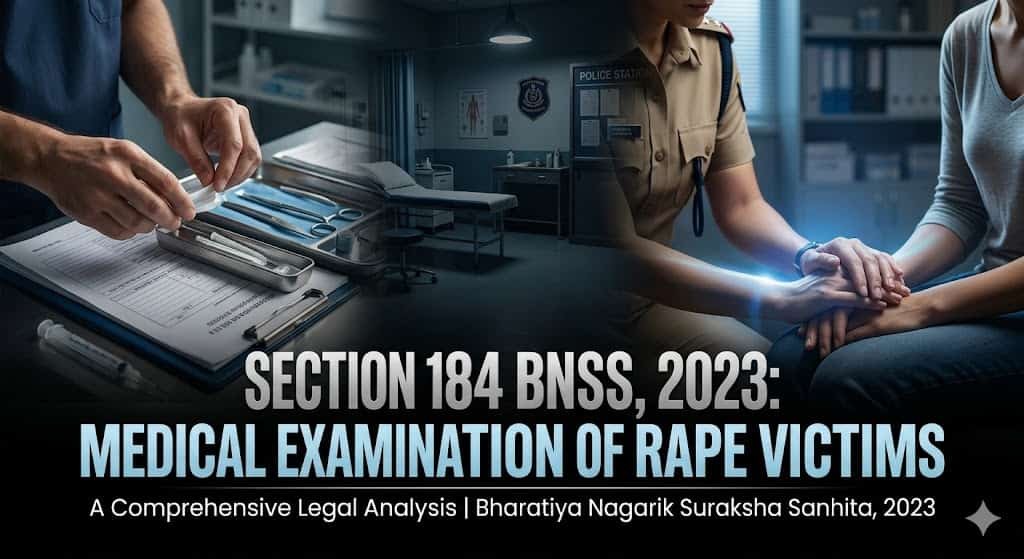
SECTION 184 BNSS, 2023 Medical Examination of Rape Victims
“When the right of an accused is taken care of from the day when FIR is registered till he is acquitted or serves his sentence, a victim is lost in the entire criminal justice system as her voice is not heard by anybody.”
— Karnataka High Court, Ajay Kumar Behera v. State of Karnataka, 2024:KHC:27306
1. Introduction
The medical examination of a rape victim is arguably the most sensitive, legally consequential, and humanly difficult step in the entire criminal justice process. It is the intersection of law, medicine, constitutional rights, and human dignity — all converging at once, often within 24 hours of a traumatic assault.
Section 184 of the Bharatiya Nagarik Suraksha Sanhita, 2023 (BNSS) governs this critical procedure. Replacing Section 164-A of the Code of Criminal Procedure, 1973 (CrPC), it came into force on July 1, 2024, as part of India’s sweeping overhaul of its criminal procedure law.
This article provides a complete legal analysis of Section 184 BNSS — its text, interpretation, landmark judicial pronouncements, constitutional underpinnings, procedural obligations, and the critical gap that courts have already flagged for legislative correction. Whether you are a practising advocate, judicial officer, medical professional, law student, or an informed citizen, this guide serves as your definitive reference.
2. Legislative Background: From Section 164-A CrPC to Section 184 BNSS
The Pre-2005 Void
Before 2005, the Code of Criminal Procedure contained no dedicated provision for the medical examination of rape victims. The procedure was unclear — whether a male or female doctor should examine, how far the examination should go, what should be documented — these questions had no legislative answer. Courts were left to fill the vacuum through judicial directions, often inconsistently.
The 2005 Amendment: Section 164-A CrPC
The Criminal Law (Amendment) Act, 2005 inserted Section 164-A into the CrPC, creating India’s first statutory framework for the medical examination of rape victims. It mandated examination by a registered medical practitioner in a government hospital, mandatory consent, and a detailed report to be submitted to the investigating officer. However, it did not specify a time limit for forwarding the report to the Magistrate.
Post-Nirbhaya Reforms and the 2013 Amendment
The brutal gang rape of December 2012 led to the Criminal Law (Amendment) Act, 2013. The Ministry of Health and Family Welfare also issued Guidelines and Protocols for Medico-Legal Care for Survivors/Victims of Sexual Violence in 2014, which became a quasi-mandatory framework for all medical examinations.
The BNSS, 2023: Continuity and One Key Addition
The BNSS, 2023, re-enacted Section 164-A largely verbatim as Section 184. The one significant change was the addition of sub-section (6), which introduced a 7-day time limit for the medical report to be forwarded to the Magistrate — plugging a gap that had long plagued cases. Unfortunately, the structural anomaly regarding female medical practitioners was carried over without correction.
3. Provision: Section 184 BNSS
| Section 184 — Medical Examination of Victim of Rape (1) Where, during the stage when an offence of committing rape or attempt to commit rape is under investigation, it is proposed to get the person of the woman with whom rape is alleged or attempted to have been committed or attempted, examined by a medical expert, such examination shall be conducted by a registered medical practitioner employed in a hospital run by the Government or a local authority and in the absence of such a practitioner, by any other registered medical practitioner, with the consent of such woman or of a person competent to give such consent on her behalf and such woman shall be sent to such registered medical practitioner within twenty-four hours from the time of receiving the information relating to the commission of such offence. (2) The registered medical practitioner, to whom such woman is sent, shall, without delay, examine her person and prepare a report of his examination giving the following particulars: (i) name and address of the woman and person by whom she was brought; (ii) age of the woman; (iii) description of material taken for DNA profiling; (iv) marks of injury, if any; (v) general mental condition; and (vi) other relevant particulars in reasonable detail. (3) The report shall state precisely the reasons for each conclusion arrived at. (4) The report shall specifically record that consent had been obtained. (5) The exact time of commencement and completion of the examination shall be noted. (6) The registered medical practitioner shall forward the report to the investigating officer, who shall forward it to the Magistrate within seven days. (7) Nothing in this section shall be construed as rendering lawful any examination without the consent of the woman or of a person competent to give such consent on her behalf. Explanation: In this section, ‘examination’ and ‘registered medical practitioner’ shall have the same meanings as in section 51. |
4. Analysis of Provision
Sub-section (1): The Core Mandate — Three Foundational Pillars
a) Who conducts the examination: The primary physician must be a registered medical practitioner employed in a government or local authority hospital. Only when unavailable may any other registered practitioner be appointed.
b) Consent is non-negotiable: Consent must be obtained from the woman, or from a person legally competent to consent on her behalf where she is incapacitated. The Supreme Court in Samira Kohli (2008) has held that consent must be free, voluntary, and informed.
c) The 24-hour rule: The victim must be referred for medical examination within 24 hours of the police receiving information. Every hour counts as biological evidence degrades rapidly.
Sub-section (2): What the Report Must Contain
Six specific particulars are mandated:
(i) Name and address — establishes identity and chain of custody
(ii) Age of the woman — critical for applicable legal provisions (e.g., POCSO if a minor)
(iii) DNA profiling material — description of samples collected (swabs, hair, blood, etc.)
(iv) Marks of injury — documents evidence of resistance, physical violence, or force
(v) General mental condition — records psychological trauma, shock, or distress
(vi) Other relevant particulars — a residual category for any significant findings
Read More: Section 173 FIR BNSS
Sub-section (3): Reasoning Must Be Stated
Every conclusion — whether corroborative or inconclusive — must be supported by reasons. A report that simply states ‘examination conducted’ without clinical reasoning has been rightly criticised by courts. This sub-section guards against mechanical, perfunctory examinations.
Sub-section (6): The 7-Day Forwarding Rule — The New Addition
This is the only substantive addition in Section 184 BNSS over its CrPC predecessor. The medical report must be forwarded by the investigating officer to the Magistrate within seven days. This plugs a critical lacuna — delays in forwarding medical reports had caused cases to weaken or collapse altogether.
Sub-section (7): Consent as an Absolute Limit
This non-obstante clause is unambiguous: nothing in Section 184 makes any examination lawful without consent. This applies even if the court orders an examination. The Supreme Court in Suchita Srivastava (2009) confirmed that bodily autonomy under Article 21 cannot be overridden even by the state.
5. Key Landmark Judgments and Judicial Interpretations
5.1 Karnataka HC: Ajay Kumar Behera v. State of Karnataka (2024:KHC:27306)
| Court: Karnataka High Court | Justice M.G. Uma | Date: July 29, 2024Most important direct interpretation of Section 184 BNSS |
This case arose from a bail application in a rape and attempted murder case. Justice Uma made path-breaking observations about Section 184 BNSS:
• Section 184 BNSS does not mandate that examination of a rape victim be conducted by a female practitioner — a stark and unjustifiable asymmetry when compared to Section 51 BNSS (which protects accused females).
• The court observed: “It is very disturbing that when such right to privacy is recognised even to an accused who is a female, there cannot be any justification for not extending such privilege to the victim.”
• Directed the Central Government to amend Section 184 to mandate female practitioner supervision.
• Interim direction: Until amendment, medical examinations of rape victims must be conducted only by or under the supervision of a female registered medical practitioner.
• The bail application was dismissed.
5.2 Supreme Court: State of Jharkhand v. Shailendra Kumar Rai — CrA 1441 of 2022
| Court: Supreme Court of India | Justices D.Y. Chandrachud & Hima Kohli | Date: October 31, 2022Landmark comprehensive ban on the two-finger test |
“This court has time and again deprecated the use of two finger test in cases alleging rape and sexual assault. The so-called test has no scientific basis. It instead re-victimises and re-traumatises women. The two finger test must not be conducted.”
“It is patriarchal and sexist to suggest that a woman cannot be believed when she states that she was raped, merely for the reason that she is sexually active.”
Directions: Any person conducting the two-finger test shall be guilty of misconduct. Union and State Governments to circulate 2014 MoHFW Guidelines to all hospitals. Medical school curricula to be reviewed.
5.3 Supreme Court: Lillu @ Rajesh & Anr v. State of Haryana — (2013) 14 SCC 643
The Supreme Court held that the two-finger test violates the right of rape survivors to privacy, physical and mental integrity, and dignity — all protected under Article 21. This judgment laid the constitutional foundation upon which all subsequent bans rest.
5.4 Supreme Court: State of Karnataka v. Shivanna alias Tarkari Shivanna — (2014) 8 SCC 913
The Supreme Court issued mandatory investigative directions for rape cases: the victim must be taken to the nearest Magistrate for Section 164 statement as a priority; as far as possible before a Lady Magistrate; and the investigating officer must record the exact time of receiving information and sending the victim for examination.
5.5 Supreme Court: Samira Kohli v. Dr. Prabha Manchanda — (2008) 2 SCC 1
Defined the contours of valid consent in medical examinations: consent must be free, voluntary, based on adequate information, and given by a person legally competent to consent. This judgment governs consent requirements under sub-sections (1) and (4) of Section 184 BNSS.
5.6 Allahabad High Court — Medical Report Quality Directions (2021)
The Allahabad High Court, disturbed to find a medical report that contained only the victim’s height and weight in the provisional opinion column, directed the UP Government to issue circulars mandating strict compliance with medical report requirements and prescribed uniform formats across all districts.
6. The Two-Finger Test: A Judicial War India Finally Won
The two-finger test (per-vaginum examination) was a highly invasive and scientifically discredited practice where a doctor inserted fingers into the vagina of a rape survivor to assess ‘habituation to sexual intercourse.’ It was used in court to cast doubt on the survivor’s credibility — with no scientific basis, no legal justification, and at enormous human cost to survivors.
Read More: Sexual Offences under BNS (Sections 63-72)
Timeline of the Judicial Battle
| Year | Development |
| 2013 | SC in Lillu v. State of Haryana declares test unconstitutional |
| 2014 | MoHFW issues Guidelines explicitly prohibiting the test |
| 2020 | Gujarat HC severely criticises continued use |
| 2022 (early) | Madras HC criticises the practice |
| 31 Oct 2022 | SC in Shailendra Kumar Rai issues comprehensive ban; declares it misconduct |
| 2024 | SC takes note in Meghalaya case; Meghalaya issues compliance circular |
Despite all this, scattered reports of the test being conducted persisted into 2024. The fight is substantially won at the level of law; implementation remains the battlefield.
7. The Critical Gap: Why Section 184 BNSS Still Falls Short
The Female Practitioner Paradox
Section 184 BNSS does not require that a rape victim be examined by or under the supervision of a female registered medical practitioner. This is deeply anomalous when read alongside other provisions of the very same statute:
• Section 51 BNSS (examination of an accused person) expressly mandates female practitioner supervision when the accused is a female.
• Section 103 BNSS requires a woman’s search to be conducted only by a female police officer.
The Karnataka High Court in Ajay Kumar Behera (2024) rightly called this an indefensible contradiction: the law is more protective of a female accused than of a rape victim.
The Constitutional Argument
The right to privacy — declared a fundamental right by the Supreme Court in K.S. Puttaswamy v. Union of India (2017) 10 SCC 1 — encompasses dignity and bodily integrity. Compelling a rape survivor to undergo intimate examination by a male doctor, when no alternative is mandated, may fall foul of Articles 14 and 21 of the Constitution.
Current Position Until Amendment
| Pursuant to the Karnataka High Court’s direction in Ajay Kumar Behera (2024), the interim position is that medical examinations of rape victims must be conducted only by or under the supervision of a female registered medical practitioner, until the legislative amendment is brought in. |
8. Section 184 BNSS vs. Section 164-A CrPC: What Changed?
| Aspect | CrPC (164-A) | BNSS (184) |
| Core mandate | Same | Same |
| Who conducts | Govt hospital practitioner | Same |
| Consent | Mandatory | Mandatory |
| 24-hour deadline | Yes | Yes |
| Report contents | 6 particulars | Same |
| Reason for conclusions | Yes | Yes |
| Time notation | Yes | Yes |
| Report forwarding deadline | NOT specified | 7 DAYS (new addition) |
| Female practitioner mandate | Not specified | Not specified (gap remains) |
9. Constitutional Angal: Article 21 and Bodily Autonomy
Section 184 BNSS is deeply embedded in the constitutional framework of Article 21 — the right to life and personal liberty. Courts have consistently held that Article 21 encompasses: (a) Right to Privacy [K.S. Puttaswamy, 2017]; (b) Right to Bodily Integrity and Autonomy [Suchita Srivastava, 2009]; and (c) Right to Dignity [Francis Coralie Mullin v. Administrator, Union Territory of Delhi, 1981].
Moreover, the 2013 criminal law amendments recognise that lack of consent — not the absence of injury — defines rape. This understanding must inform how Section 184 examinations are conducted. A medical report’s finding of ‘no injury’ is legally irrelevant to the question of rape.
10. Role of Medical Practitioners: Duties, Liabilities, and Protocols
Duties Under Section 184 BNSS
7. Conduct examination without delay upon receiving the victim
8. Obtain and record consent explicitly — failure renders the examination unlawful
9. Prepare a comprehensive report addressing all six particulars in sub-section (2)
10. State reasons for every conclusion — no conclusory statements without clinical basis
11. Note exact examination times — commencement and completion
12. Forward the report within 7 days to the investigating officer
What Practitioners Must NOT Do
• Conduct the two-finger test — this is professional misconduct (Shailendra Kumar Rai, 2022)
• Comment on the victim’s ‘sexual history’ or ‘habituation to sexual intercourse’
• Write vague, incomplete, or illegible reports — Karnataka HC directed computer-generated or legibly written reports
• Delay examination or report submission without cause
Liability for Lapses
A medical practitioner who fails to comply may face: disciplinary action by the National Medical Commission; finding of professional misconduct; adverse inference in criminal proceedings; and civil liability for harm to the investigation.
Section 144 ORDER FOR MAINTENANCE OF WIVES, CHILDREN AND PARENTS, BNSS
11. Ministry of Health Guidelines 2014: Continuing Relevance
The Guidelines and Protocols for Medico-Legal Care for Survivors/Victims of Sexual Violence (MoHFW, 2014) supplement Section 184 BNSS and remain fully operative. Key provisions:
• No per-vaginum test — explicitly prohibited; ‘the size of vaginal introitus has no bearing on a case of sexual violence’
• No comment on habituation — doctors must not record opinions on past sexual history
• Mandatory treatment — under Section 396 BNSS, all hospitals must provide first aid and treatment free of cost; no hospital can refuse pending police procedures
• Comprehensive sample collection — specific protocols for swabs, blood, hair, nail scrapings, and clothing for DNA analysis
• Psychological support — examination must be accompanied by crisis counselling
12. Practical Implications for Lawyers, Police, and Survivors
For Advocates
• Challenge delay: Any failure to refer the victim for examination within 24 hours is an investigative lapse.
• Examine the report forensically: Check whether all six particulars are addressed and reasons stated for each conclusion.
• Cite Karnataka HC direction: In cases where a male doctor examined the victim, cite Ajay Kumar Behera (2024) and argue violation of the victim’s right to privacy.
• Two-finger test findings are inadmissible: Immediately raise an objection if the report contains per-vaginum findings.
For Police Officers
• Refer the victim for examination within 24 hours — a statutory obligation, not a procedural convenience.
• Forward the medical report to the Magistrate within 7 days — violation of sub-section (6) can be grounds for adverse comment.
• Ensure a female registered medical practitioner is available at the hospital.
For Survivors and Their Families
• Right to consent: No examination can be forced under any circumstances.
• Right to demand a female doctor: Judicially backed by the Karnataka HC (2024) direction.
• Right to free treatment: Under Section 396 BNSS, no hospital can deny treatment because of pending police formalities.
• The two-finger test is illegal: Report any attempt — it constitutes professional misconduct.
• A ‘no injury’ report is not a verdict: Absence of injury does not mean rape did not occur.
13. Pending Amendments and the Way Forward
The Karnataka High Court’s direction in Ajay Kumar Behera (2024) is a judicial push to Parliament for urgent amendment. The proposed amendment to Section 184 BNSS should:
13. Mandate that the medical examination of a rape victim be conducted by or under the supervision of a female registered medical practitioner.
14. Include explicit protocols for psychological assessment alongside physical examination.
15. Define consequences for non-compliance by medical practitioners.
Beyond Section 184, broader systemic reforms are needed: designated Sexual Assault Response Centres (SARCs) in every district hospital; training of forensic medical officers on trauma-informed examination; uniform digital reporting formats; and more effective implementation of victim compensation under Nipun Saxena v. Union of India (SC, 2019).
Difference between Summons Case, Warrant Case and Sessions Case under BNSS
14. Frequently Asked Questions (FAQs)
Q1. What is Section 184 of BNSS?
Section 184 of the Bharatiya Nagarik Suraksha Sanhita, 2023 (BNSS) is the statutory provision governing the medical examination of a rape victim during a criminal investigation. It replaced Section 164-A of the CrPC and came into force on July 1, 2024. It mandates consent-based examination by a registered medical practitioner, prescribes what the report must contain, and sets a 7-day deadline for the report to be forwarded to the Magistrate.
Q2. Is the medical examination of a rape victim mandatory under Section 184 BNSS?
The examination is mandatory in the sense that the investigating officer is legally obligated to refer the victim within 24 hours when proposed during investigation. However, the victim’s consent is an absolute prerequisite — sub-section (7) expressly provides that no examination is lawful without consent. The victim can refuse the examination or refuse specific parts of it.
Q3. Can a rape victim be examined without her consent under Section 184 BNSS?
No. Section 184(7) is categorical: nothing in the section renders lawful any examination conducted without the consent of the woman or a person competent to give consent on her behalf. No court, police officer, or hospital authority can legally compel a rape victim to undergo medical examination.
Q4. Does Section 184 BNSS require that the rape victim be examined by a female doctor?
As of this article’s date, Section 184 BNSS does not expressly require this. However, the Karnataka High Court in Ajay Kumar Behera v. State of Karnataka (2024:KHC:27306) has directed that until Parliament amends the provision, rape victims must be examined only by or under the supervision of a female registered medical practitioner.
Q5. What is the 7-day rule under Section 184(6) BNSS?
Sub-section (6) requires the registered medical practitioner to forward the examination report to the investigating officer, who must then forward it to the Magistrate within seven days. This is a new addition in BNSS — the corresponding CrPC provision (Section 164-A) had no such deadline. Non-compliance can be raised as an investigative lapse.
Q6. What is the two-finger test, and is it allowed under Section 184 BNSS?
The two-finger test (per-vaginum examination) was a highly invasive and scientifically discredited practice. It is completely banned in India. The Supreme Court in State of Jharkhand v. Shailendra Kumar Rai (CrA 1441 of 2022, October 31, 2022) ruled that any person conducting this test is guilty of professional misconduct. Under Section 184 BNSS, this test is impermissible in any circumstance.
Q7. What must the medical report under Section 184 BNSS contain?
The report must include: (i) name and address of the woman and the person accompanying her; (ii) her age; (iii) description of material collected for DNA profiling; (iv) marks of injury, if any; (v) general mental condition; and (vi) other relevant particulars in reasonable detail. Every conclusion must state reasons. The report must record that consent was obtained, and note the exact start and end time of the examination.
Q8. Is a ‘no injury’ report a death knell for a rape case?
Absolutely not. The Supreme Court has repeatedly held that absence of injury does not disprove rape. Modern jurisprudence recognises that penetration without visible injury is medically possible, and that freezing due to trauma can prevent physical resistance. A conviction in a rape case can be secured on the sole testimony of the victim if found reliable, even if the medical report is inconclusive.
Q9. What happens if the medical examination is not conducted within 24 hours?
A failure to refer the victim for examination within 24 hours is a statutory violation and constitutes an investigative lapse. Courts have authority to draw adverse inferences against the investigating agency. However, delay alone does not necessarily destroy the prosecution’s case — courts examine the cause of the delay and whether it was attributable to police inaction or the victim’s own circumstances.
Q10. Are private hospitals required to examine rape victims under Section 184 BNSS?
Section 184 BNSS mandates examination by a government or local authority hospital practitioner primarily. However, Section 396 BNSS (formerly Section 357-C CrPC) requires all hospitals — government and private — to provide immediate first aid and medical treatment to rape survivors free of cost, regardless of police formalities. Refusal constitutes a punishable offence.
Q11. What is the difference between Section 184 BNSS and Section 51 BNSS?
Section 51 BNSS deals with the medical examination of an accused person at the request of the police during investigation, whereas Section 184 BNSS deals with the medical examination of a rape victim. Section 51 expressly provides that when the person to be examined is a female, the examination must be conducted or supervised by a female practitioner. This protection is inexplicably absent in Section 184 — a gap the Karnataka High Court has urged Parliament to correct.
Q12. Who can give consent on behalf of a rape victim who is incapacitated?
If the woman is a minor or otherwise incapacitated, consent may be given by a parent, guardian, or in their absence, a Child Welfare Committee member (in POCSO cases) or a court-appointed authority. The doctrine of informed consent (Samira Kohli, 2008) requires that this person be adequately informed before giving consent.
धारा 118 BNS क्या है? | Section 118 BNS in Hindi — खतरनाक हथियार से चोट, सजा, जमानत और पूरी जानकारी (2026)
15. Conclusion
Section 184 of the BNSS, 2023 occupies a unique position in Indian criminal law — it is the point where justice either begins or breaks down. A properly conducted, sensitively documented, and promptly forwarded medical examination can be the difference between a conviction and an acquittal, between a survivor being believed and being dismissed.
The provision represents legislative progress — the 7-day reporting rule, the explicit consent requirements, and the detailed reporting mandates are all steps forward. But as the Karnataka High Court powerfully observed in 2024, the failure to mandate female medical practitioners for the examination of rape victims is not a mere technical gap — it is a systemic failure that sends a message India can no longer afford to send.
The Supreme Court’s firm rejection of the two-finger test, the constitutional protection of bodily autonomy, and the growing body of victim-centric jurisprudence all point in one direction: the criminal justice system must treat the medical examination of a rape survivor not as an evidence-collection exercise, but as the first official act of a state that stands beside her.
| The amendment to Section 184 BNSS mandating female medical practitioners is not just a legal reform. It is a statement of values. |
Legal Disclaimer
This article is intended for academic, educational, and informational purposes only. It does not constitute legal advice. Readers requiring legal assistance should consult a qualified advocate. Case citations have been included for reference; readers are advised to access original judgments from official sources such as the Supreme Court of India (sci.gov.in) and respective High Court websites.
© 2026 | Section 184 BNSS: Medical Examination of Rape Victims — A Comprehensive Legal Analysis